NEED HELP FAST? We have over 40 years' experience with Bulk Material Handling, Packaging, and Processing.   (979) 217-1480 GET A QUOTE

NEED HELP FAST?   (979) 217-1480   GET A QUOTE

7 Tips for Buying Vacuum Seal Pouches?

Choosing Vacuum Seal Pouches looks simple until product protection, storage conditions, and sealing equipment enter the decision. A pouch that feels strong may still fail around sharp edges, uneven seals, or repeated freezing. The right choice depends on barrier performance, film structure, thickness, dimensions, and intended use.

The Food and Agriculture Organization has reported that roughly one-third of food produced globally is lost or wasted. Better packaging cannot solve every cause, but it can help protect quality during handling and storage. Smithers’ flexible packaging research also identifies barrier performance, material efficiency, and recyclability as important industry priorities. These findings make pouch selection more than a price comparison. It becomes a practical quality-control decision.

Small details matter. Check whether the pouch suits your sealer. Confirm its oxygen and moisture resistance. Test it with the actual product, not an empty sample. For food applications, reduced-oxygen packaging also requires careful temperature control. USDA FSIS guidance highlights the importance of safe handling and validated storage procedures.

The thickest pouch is not always the best pouch. That assumption deserves testing. A heavy film may increase cost without improving real-world performance. Meanwhile, a lightweight option may puncture beside a bone, shell, or frozen corner. The following seven tips explain how to compare Vacuum Seal Pouches with greater confidence, clearer specifications, and fewer expensive surprises. Results can vary. Supplier documentation still needs verification.
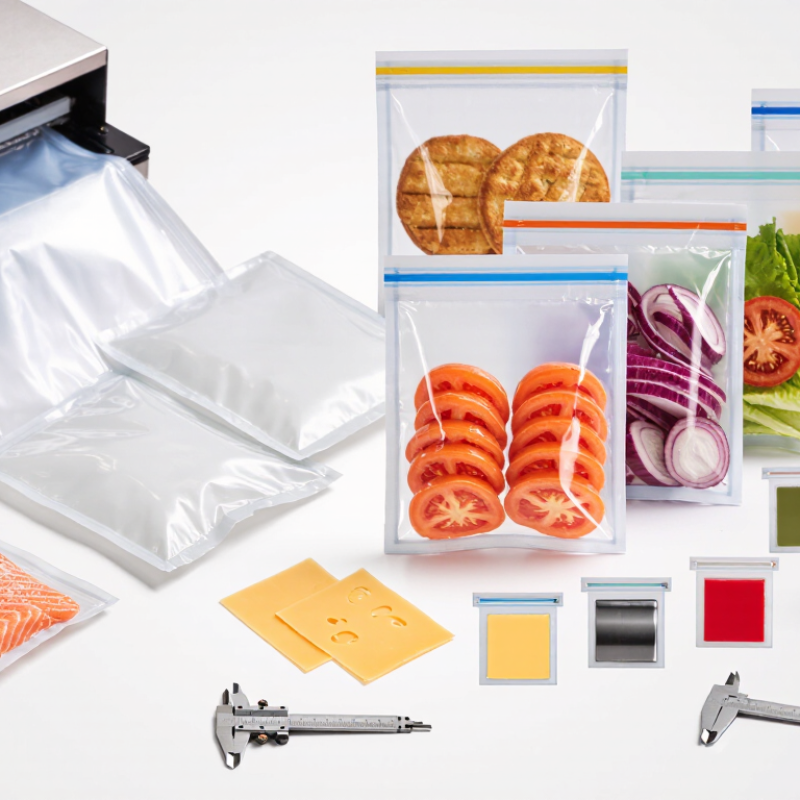
7 Tips for Buying Vacuum Seal Pouches?

Identify the Right Pouch Size for Your Sealing Needs

7 Tips for Buying Vacuum Seal Pouches

Identify the right pouch size before comparing materials or prices. Measure the item’s length, width, and height at its widest points. Add about 2 to 3 inches for a reliable seal area. Measure twice. Leave room.

A pouch that is too tight may strain the seal during vacuuming. An oversized pouch wastes material and can take longer to evacuate. For irregular foods, choose a width that allows the item to lie flat. Keep sharp bones and corners away from the film, or cover them with protective material. I once selected a pouch by length alone, and the narrow opening made loading awkward. That was a useful mistake.

Check the opening size against your sealing equipment. The pouch should sit flat across the sealing bar without wrinkles. Wrinkles can create tiny air channels and weaken the closure. For moist foods, leave extra space above the liquid line. This helps prevent liquid from reaching the seal. A pouch with 2 to 3 inches of clear top space is often easier to handle. Still, the ideal space depends on the item’s shape and the machine’s performance. Test one pouch before buying in bulk. Inspect the seal for a continuous, firm line, then gently pull the edges apart. A poor test result needs investigation, not optimism. Verify the pouch thickness, temperature range, and food-contact information in the supplier’s specifications.

Choose a Material Suited to Your Food and Storage Conditions

Choosing the right pouch material matters more than chasing the lowest price. In practical food packing, I check the food, temperature, moisture, and handling risks together. Feel it first. A soft pouch suits many dry foods, but sharp bones or frozen edges can puncture thin film. For everyday freezer storage, multilayer nylon and polyethylene offer useful strength and reliable heat sealing. However, not every pouch handles boiling temperatures or extended sous vide cooking.

Moist foods need stronger seals and better protection against leaks. Oily foods may also require a film designed for grease exposure. For coffee, dried fruit, or other oxygen-sensitive foods, choose a pouch with stronger oxygen and moisture barriers. Light-sensitive ingredients may need an opaque structure. Clear film is convenient, but it exposes food to light during storage. That detail is easy to overlook.

Storage conditions should guide the material choice. Freezing, refrigeration, room-temperature storage, and heated cooking place different demands on the pouch. Check the supplier’s food-contact documentation and temperature guidance before purchasing. I once focused too heavily on thickness and ignored seal quality; that was a costly mistake. A thick pouch with a weak seal still fails. Leave enough space above the food for a clean seal, and avoid stretching the film around rigid pieces. Test a few pouches with your actual food before ordering in bulk. My own selection process is still imperfect, especially when one pouch must serve several storage conditions.

Check Thickness, Strength, and Puncture Resistance

Buying vacuum seal pouches is not only about choosing the thickest film.

The 2024 Flexible Packaging Association State of the Industry report placed U.S. flexible packaging sales near $40 billion in 2023. That scale reflects a demanding market, where material performance matters. A pouch should feel firm, not brittle.

For dry foods, 70–90 microns may work well. Bone-in meat or sharp frozen items often need 120 microns or more. These figures are practical starting points, not universal rules.

Check tensile strength and seal strength separately. A thick pouch can still fail at the seal. ASTM F88 testing measures the force needed to separate sealed layers, while ASTM D1709 evaluates impact resistance. Ask for test results, not vague claims.

Puncture resistance matters most around corners, bones, and hard edges. Press a filled sample against a clean, blunt surface. Then inspect tiny white stress marks or slow leaks.

Do not judge quality by appearance alone. A glossy pouch may perform poorly under pressure. I have found that overfilling creates more failures than buyers expect. Leave enough space for a flat, even seal.

Also compare results after freezing, since cold films can become less flexible. The wrong pouch may survive sealing but fail during storage.

Small test batches are wiser than a large first order.

Confirm Compatibility With Your Vacuum Sealer

Confirm Compatibility With Your Vacuum Sealer

Before buying vacuum seal pouches, check how your sealer removes air. Chamber machines usually work with smooth pouches, while external suction models often need textured channels. A flat pouch may seal correctly but fail to evacuate air. I learned this after testing a smooth bag on a household suction unit. It sealed tightly. The air remained inside.

Measure the sealing area, not only the pouch width. The pouch should fit comfortably inside the machine’s sealing bar. Leave enough space above the food for a clean seal, usually several centimeters. Check the recommended pouch thickness and material, too. Some sealers struggle with heavy multilayer film, while thin film may wrinkle near the heat strip. Small wrinkles matter.

Test one pouch before purchasing a large quantity. Place a dry item inside and inspect the seal after cooling. It should look even, firm, and continuous. Try a gentle pull by hand. Do not assume every pouch described as “universal” will suit every machine. That wording can be vague. Compatibility also depends on food moisture, pouch texture, and sealing temperature. If the first test fails, record what happened instead of blaming the machine immediately. My own early tests were not perfect; changing the pouch position solved a problem I first thought required stronger suction.

7 Tips for Buying Vacuum Seal Pouches? - Confirm Compatibility With Your Vacuum Sealer

Use this checklist to compare pouch specifications before purchasing.

Tip Compatibility Dimension Recommended Specification How to Confirm Before Buying Why It Matters
1 Sealer Type Use textured or channel-style pouches for most external suction sealers. Use smooth pouches only when the machine is designed for chamber operation. Identify whether the sealer is an external suction model or a chamber model. Check the user manual or pouch instructions. External suction machines need an embossed channel to help remove air through the pouch surface.
2 Pouch Width Choose a pouch that is narrower than the sealer's maximum sealing width. Leave clearance on both sides of the contents. Measure the machine's maximum seal bar width and compare it with the pouch width. Do not rely only on the listed pouch length. A pouch that is too wide may not fit correctly or may not receive a complete seal across its opening.
3 Material Structure Look for food-contact packaging with a heat-sealable inner layer and an oxygen- and moisture-resistant outer layer. Common structures include polyethylene combined with nylon. Review the material specification, food-contact statement, and intended use. Avoid unmarked packaging for food storage. The inner layer must melt and bond during sealing, while the outer layer helps provide strength and barrier protection.
4 Film Thickness For general household food storage, approximately 70–120 micrometres is a practical range. Select thicker film for sharp, heavy, or irregular contents. Compare the stated thickness with the sealer's recommended pouch range and inspect whether the pouch feels strong enough for the intended contents. Thicker film generally improves puncture resistance, but excessive thickness may require more heat or sealing time.
5 Seal Area and Opening Keep the top opening clean, flat, and dry. Allow at least 5–8 cm of empty space above the food for positioning and sealing. Check the pouch dimensions after filling, not only when empty. Make sure folds, liquid, crumbs, and grease will not enter the seal area. Contamination or insufficient headspace can cause weak seals, air leaks, or wrinkled sealing lines.
6 Temperature and Use Conditions Buy pouches specifically rated for the intended use, such as refrigerator storage, freezer storage, boiling, or sous-vide cooking. Check the stated temperature range and time limits. Do not assume that a freezer-rated pouch is suitable for boiling or cooking. Different applications require different heat resistance, seal strength, and material performance.
7 Trial Sealing and Leak Test Test a small quantity before purchasing in bulk. Inspect the seal for a continuous, smooth bond with no channels or wrinkles. Run a pouch with a dry, non-sharp item, then gently press the package and check for air returning to the pouch. Actual performance depends on pouch material, machine settings, contents, and sealing technique.

Compare Safety, Reusability, and Overall Value

7 Tips for Buying Vacuum Seal Pouches

Compare Safety, Reusability, and Overall Value

Start with food-contact compliance, not glossy thickness. Look for clear material specifications and temperature limits. The FDA Food Code 2022 recommends holding cold food at 41°F (5°C) or below. USDA FSIS recommends refrigerators remain at 40°F (4°C) or below. Vacuum sealing slows oxidation. It does not make raw meat shelf-stable. Choose pouches with strong seams, compatible textures, and enough space above the seal. A weak seam ruins the savings.

Test the pouch before buying in bulk. Fill one with water, seal it, and press the edges gently. Watch for bubbles or channels. Avoid pouches that split near sharp bones or frozen corners. Reusability needs caution. Washable pouches may suit dry foods, but raw meat creates higher cleaning demands. I once trusted a pouch because it looked clean after washing. That judgment was too casual. Use separate pouches for raw proteins and ready-to-eat foods. Discard any pouch with stains, odors, scratches, or a weakened seal.

Value depends on safe uses, not the lowest price. Divide the package cost by realistic reuse cycles. Also consider wasted food, failed seals, electricity, and storage space. UNEP’s 2023 Turning off the Tap report identifies packaging as responsible for about 40% of global plastic use. Thinner material can reduce waste, but only if it survives handling. Choose the smallest practical size, buy consistent dimensions, and record how many cycles each pouch truly manages. The result may challenge your first assumption.

7 Tips for Buying Vacuum Seal Pouches

Compare food-contact safety, durability, reusability, and overall value before choosing vacuum seal pouches.

Choose pouches made from food-contact-safe materials, match the pouch size to the item, and select a thickness suited to sharp or heavy foods. Smooth-channel pouches generally provide reliable air removal, while textured pouches are often needed for external vacuum sealers. Heat-rated pouches are appropriate for sous vide only when the manufacturer specifically confirms that use. Reusable designs can reduce waste, but they should be washed thoroughly, dried completely, and replaced after visible wear, seal damage, or odor retention. The value scores are practical comparison ratings based on typical durability, safe-use flexibility, waste reduction, and cost over repeated use; actual performance varies by product.