NEED HELP FAST? We have over 40 years' experience with Bulk Material Handling, Packaging, and Processing. (979) 217-1480 GET A QUOTE
NEED HELP FAST? (979) 217-1480 GET A QUOTE

Automated filling machines measure and dispense liquids, creams, powders, or granules into containers with controlled accuracy. They appear in food, beverage, cosmetics, chemical, and pharmaceutical production. According to PMMI’s State of the Industry research, manufacturers continue investing in automation because labor shortages, production consistency, and flexible packaging formats remain major operational pressures. These machines answer those pressures, but they do not remove every production problem.
A typical system begins with container positioning. Sensors detect each bottle, pouch, jar, or vial before filling starts. A programmable logic controller then coordinates pumps, valves, nozzles, conveyors, and safety interlocks. Volumetric systems measure liquid by space. Flow meters measure movement. Piston fillers use a calibrated chamber. Time-pressure systems rely on controlled air pressure. The right method depends on viscosity, foaming behavior, temperature, container shape, and required accuracy.
Small differences matter. A thick lotion may cling to a nozzle. A carbonated drink may foam during filling. Operators often adjust speed, pressure, nozzle height, and cleaning cycles to stabilize output. The machine is not truly “automatic” without suitable product data and regular verification. That point deserves more attention.
Grand View Research and MarketsandMarkets both identify automation and packaging efficiency as important forces in the filling equipment market. However, market forecasts vary because researchers define equipment categories differently. Buyers should therefore examine technical specifications, validation records, changeover time, and service support rather than rely on market growth figures alone. In practice, a reliable automated filling machines setup combines precise hardware, trained operators, documented sanitation, and continuous quality checks. It should fill accurately today. It must also remain maintainable tomorrow.
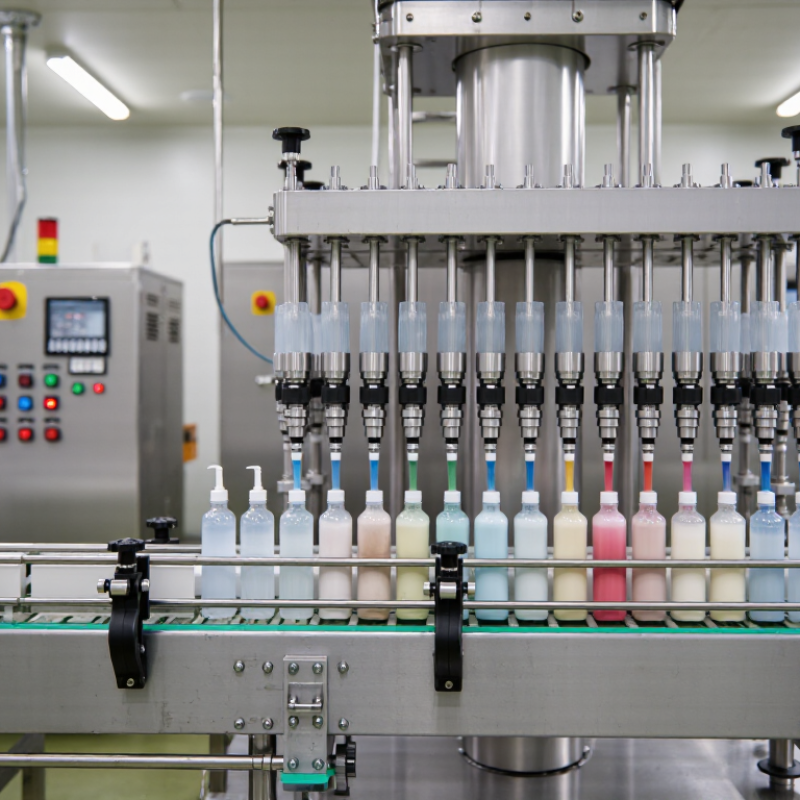
Automated filling machines are industrial systems that measure and dispense liquids, creams, powders, or small solid products into containers. They reduce repetitive manual work and help keep each container close to the target quantity. These machines are common in food, beverage, cosmetic, chemical, and household-product production.
A typical system uses a product tank, pump, filling nozzle, sensors, and a control panel. Empty containers move into position on a conveyor. Sensors detect their location, then the nozzles release a measured amount. The control system may measure volume, weight, time, or piston movement. After filling, the containers continue toward capping, labeling, or inspection equipment. The exact method depends on product thickness, container shape, and required accuracy.
Automation is not magic. A thick lotion may flow slowly, while a foamy liquid can create unstable levels. Temperature changes can also affect filling performance. Operators still need to check nozzle alignment, clean product-contact parts, and verify measurements during production. A small calibration error can affect hundreds of containers. The machine does not replace judgment; it makes careful procedures easier to repeat. In practice, reliable results come from suitable settings, regular maintenance, and documented quality checks.
Automated filling machines transfer measured products into bottles, jars, pouches, or other containers. Their performance depends on several connected components. The hopper stores the product and keeps it available for filling. A pump moves liquids, while a screw or piston handles thicker materials. Valves control product flow and reduce dripping. Nozzles then deliver the measured amount into each container.
Sensors detect container position, fill level, and product movement. A programmable controller uses these signals to coordinate pumps, valves, and conveyor speed. The human-machine interface allows operators to adjust volume, timing, and production settings. Some systems use load cells to check weight during filling. Guards and emergency stops support safer operation. However, sensors can become dirty, and small calibration errors may affect accuracy.
Tips: Keep nozzles aligned and inspect seals during every shift. Clean product-contact parts according to the machine’s procedure. Record fill weights regularly, not only when problems appear. Stable product temperature also helps maintain consistent flow. No machine is perfectly self-correcting. A setting that works today may need adjustment tomorrow, especially when viscosity, container shape, or room temperature changes. Careful observation remains an essential part of reliable operation.
Automated filling machines measure and dispense products into containers with repeatable control. The process begins when empty bottles arrive on a conveyor. An indexing system separates them into fixed positions. Sensors confirm their presence and detect misalignment. No container, no fill.
The filling cycle then starts. Nozzles descend or move into position. A pump, gravity system, or flowmeter delivers the required volume. Liquid level, weight, or flow data controls the release point. For viscous products, the machine may slow the pump near the target volume. This reduces splashing and foam. The International Federation of Robotics reported 541,302 industrial robots installed worldwide in 2023, showing how widely automated control is entering production environments. Yet filling still depends on product behavior.
After dispensing, nozzles retract and containers move toward inspection. Checkweighers identify underfilled or overfilled units. A reject mechanism removes failed containers without stopping the entire line. Operators review alarms, container samples, and trend data. According to the U.S. Food and Drug Administration’s Process Validation guidance, manufacturers should monitor process variation throughout production, not only test finished products. That matters because temperature can change viscosity, while trapped air can distort readings. The machine may appear precise. It can still be wrong.
Cleaning follows the production schedule. Some systems use automated rinse cycles, while others require partial disassembly and inspection. In real facilities, sensors occasionally misread clear liquids or reject good containers. Those weaknesses deserve attention. Reliable filling comes from calibration, documented checks, and experienced operators working together.
Common Types of Automated Filling Machines
Automated filling machines dispense measured products into containers with limited manual handling. Their design depends on viscosity, container shape, filling speed, and production hygiene. In practice, operators usually test several samples before choosing equipment. Product behavior can change with temperature, which is easy to overlook.
Gravity fillers use product height and natural flow. They suit thin liquids with stable viscosity, such as water-like solutions. Overflow fillers return excess liquid to a holding tank, creating consistent levels inside transparent containers. Piston fillers use a measured chamber for thicker products, including creams, sauces, and gels. Their volume accuracy depends on piston size and proper calibration.
Pump fillers move products through controlled pumping cycles. They handle liquids that vary in thickness, although the pump must match the product carefully. Time-pressure fillers use air pressure and timed valves for fast, low-viscosity filling. Auger fillers are common for powders and fine granules. A rotating screw controls the amount delivered, but dust can affect sensors and seals.
Some systems combine filling methods on one production line. That flexibility sounds useful. However, complicated equipment may demand more cleaning time and operator training. Reliable results require container checks, nozzle adjustment, regular calibration, and documented trial runs. A machine can reach its advertised speed, yet poor product flow may cause splashing, foam, or uneven weights. Experienced technicians watch these details before approving full-scale operation.
| Machine Type | Basic Operating Principle | Typical Products | Common Fill Range | Typical Accuracy | Production Characteristics | Best-Suited Applications | Important Considerations |
|---|---|---|---|---|---|---|---|
| Volumetric Cup Filler | Adjustable cups are filled to a set volume and discharged into containers. | Dry grains, seeds, powders, snacks, and granules | Approximately 20 mL to 2,000 mL | Usually about ±1% to ±3%, depending on product consistency | High-speed, mechanically simple, and suitable for free-flowing products | Products with relatively uniform particle size and density | Changes in bulk density or particle size can affect weight accuracy. |
| Auger Filler | A rotating screw conveys a measured quantity of product from a hopper into each container. | Flour, spices, coffee, powdered chemicals, and nutritional powders | Approximately 1 g to 5,000 g | Often about ±1% to ±2%, depending on powder properties | Controlled dosing for powders; speed is adjusted by screw rotation and filling time | Free-flowing and non-free-flowing powders | Dust control, hopper agitation, and screw design are important for stable dosing. |
| Piston Filler | A piston draws product into a cylinder and pushes a measured volume through a filling nozzle. | Thick sauces, creams, pastes, gels, and semi-solid foods | Approximately 10 mL to 10,000 mL | Commonly about ±0.5% to ±1% | Positive-displacement filling with strong performance for viscous products | High-viscosity liquids and products containing particulates | Product temperature and viscosity can influence fill consistency. |
| Peristaltic Pump Filler | Flexible tubing is compressed by rotating rollers to move a controlled volume of liquid. | Pharmaceutical liquids, laboratory solutions, beverages, and sensitive fluids | Approximately 0.1 mL to 5,000 mL | Often about ±0.5% to ±2% | Product contacts only the tubing, supporting hygienic and low-contamination filling | Sterile, shear-sensitive, or contamination-sensitive liquids | Tubing wear and elasticity must be monitored and the tubing replaced regularly. |
| Gear Pump Filler | Intermeshing gears transfer liquid at a controlled rate while the system measures fill time or volume. | Oils, syrups, detergents, inks, and other uniform liquids | Approximately 5 mL to 10,000 mL | Typically about ±0.5% to ±1% | Provides accurate metering and continuous flow for low- to medium-viscosity liquids | Clean, homogeneous liquids requiring precise dosing | Abrasive particles and large suspended solids may increase pump wear. |
| Time-Pressure Filler | Compressed air or gas applies pressure to a product tank for a preset time, forcing liquid through nozzles. | Low- to medium-viscosity liquids, including beverages and cleaning solutions | Approximately 5 mL to 5,000 mL | Usually about ±0.5% to ±2%, depending on viscosity and pressure stability | Few moving product-contact parts and relatively straightforward cleaning | Free-flowing liquids with stable viscosity | Accuracy depends on consistent air pressure, product level, temperature, and fill time. |
| Overflow Filler | Each container is filled to the same visible liquid level; excess product returns to the supply tank. | Water, juice, shampoo, liquid soap, and other thin liquids | Approximately 50 mL to 5,000 mL | Excellent level uniformity; weight accuracy is commonly about ±1% to ±2% | Creates a consistent appearance across transparent containers | Thin liquids packaged in bottles where visual fill level matters | Foaming, container shape, and product surface tension can affect performance. |
| Net-Weight Filler | Load cells measure the product mass while a controller stops the filling process at the target weight. | Powders, granules, liquids, and products with variable bulk density | Approximately 50 g to 25 kg or more | Often about ±0.1% to ±0.5% of target weight | Direct weight control helps maintain the declared package quantity | Products whose density varies or where weight compliance is critical | The system requires stable scales, vibration control, and regular calibration. |
| Rotary Filler | Containers move around a rotating carousel and pass multiple filling stations in sequence. | Liquids, powders, creams, and other products depending on the installed dosing system | Varies by dosing technology and container format | Depends on the integrated filling method and control system | High throughput with a compact footprint and continuous container movement | Large-volume production using standardized containers | Changeovers can require more time when container sizes or formats vary significantly. |
| Inline Filler | Containers travel in a straight line, stop or move beneath filling nozzles, and then continue to downstream equipment. | Beverages, household chemicals, cosmetics, sauces, and pharmaceuticals | Varies by nozzle configuration and container size | Depends on the selected pump, valve, or weighing system | Flexible layout, accessible operation, and relatively convenient product changeover | Small- to large-scale lines with multiple container formats | The line needs synchronized conveyors, sensors, nozzles, and container-spacing controls. |
| Monoblock Filler | Filling is integrated with one or more operations such as capping, sealing, rinsing, or labeling in a connected machine. | Liquid foods, beverages, cosmetics, and pharmaceutical products | Varies by integrated equipment and container format | Depends on the filling technology and in-line inspection controls | Reduces manual handling and saves floor space by combining several processes | Automated packaging lines with limited space or strict handling requirements | Integrated systems can be more complex to maintain and may require skilled setup personnel. |
| Aseptic Filler | Sterilized product and packaging materials are filled and sealed within a controlled environment to limit microbial contamination. | Long-life beverages, sterile pharmaceutical products, and nutritional liquids | Varies by package type and product category | Controlled through validated filling, sterilization, and inspection procedures | Supports extended shelf life without relying solely on refrigeration | Commercially sterile products requiring high hygiene control | Validation, environmental monitoring, sterilization procedures, and hygienic design are essential. |
What Are Automated Filling Machines and How Do They Work?
Automated filling machines dispense measured volumes into bottles, jars, pouches, or other containers. A pump, piston, gravity system, or flow meter controls the product dose. Sensors detect each container, while valves open and close through programmed timing. Modern systems can also record batch data and reject underfilled containers. The International Federation of Robotics reported 541,302 new industrial robots installed worldwide in 2023. Filling lines are not always robotic, but this figure reflects wider automation growth.
Applications vary across food, beverages, cosmetics, household products, and regulated medicines. Liquid products may require different systems for water-like flow, high viscosity, particles, or foam. A filling line can improve repeatability, reduce spills, and support traceable production. PMMI industry reports frequently identify labor availability, uptime, and flexible packaging as major equipment investment factors. The gains are practical. A stable nozzle can prevent a sticky residue around every cap.
Operating conditions deserve careful attention. Product temperature, container shape, line speed, and cleaning requirements affect accuracy. Changeover time also matters when several sizes share one machine. Operators should verify calibration, sensor performance, guarding, and cleaning procedures before production. Faster is not always better. Excessive speed can increase foaming, splashing, or rejected containers. Some facilities also underestimate training needs, which can weaken an otherwise capable system. Proper validation and routine inspection remain essential, especially when small errors can multiply across thousands of units.