NEED HELP FAST? We have over 40 years' experience with Bulk Material Handling, Packaging, and Processing. (979) 217-1480 GET A QUOTE
NEED HELP FAST? (979) 217-1480 GET A QUOTE

China has become a major sourcing base for automotive filtration components, including the car engine air filter. Its factories offer broad material choices, automated pleating, and competitive production costs. However, a low quotation does not prove reliable filtration. Paper quality, sealing accuracy, dust-holding capacity, and batch consistency deserve closer inspection.
Grand View Research estimates that the global automotive filters market will continue expanding through 2030, supported by vehicle production, stricter emission expectations, and replacement demand. The report also highlights growing interest in efficient filtration systems. A separate EPA technical study found that replacing a severely clogged filter can improve acceleration in some vehicles. It did not confirm universal fuel-economy gains. That difference matters.
As legendary engine builder Smokey Yunick said, “An engine is nothing more than an air pump.” The car engine air filter controls what enters that pump. Fine dust can reach cylinder walls, turbocharger components, and sensitive airflow sensors. A suitable supplier should therefore provide measurable test results, not attractive photographs alone. ISO 5011 testing can help compare filtration efficiency, restriction, and dust capacity under controlled conditions.
Chinese suppliers vary considerably. Some maintain traceable materials and automated inspection. Others still depend heavily on manual assembly. This is where buyers can make mistakes. A supplier audit, sample testing, and long-term batch review remain essential. Product claims may sound precise, yet real-world performance can change after vibration, humidity, or imperfect installation. The best sourcing decision balances price, engineering evidence, delivery stability, and honest technical communication.
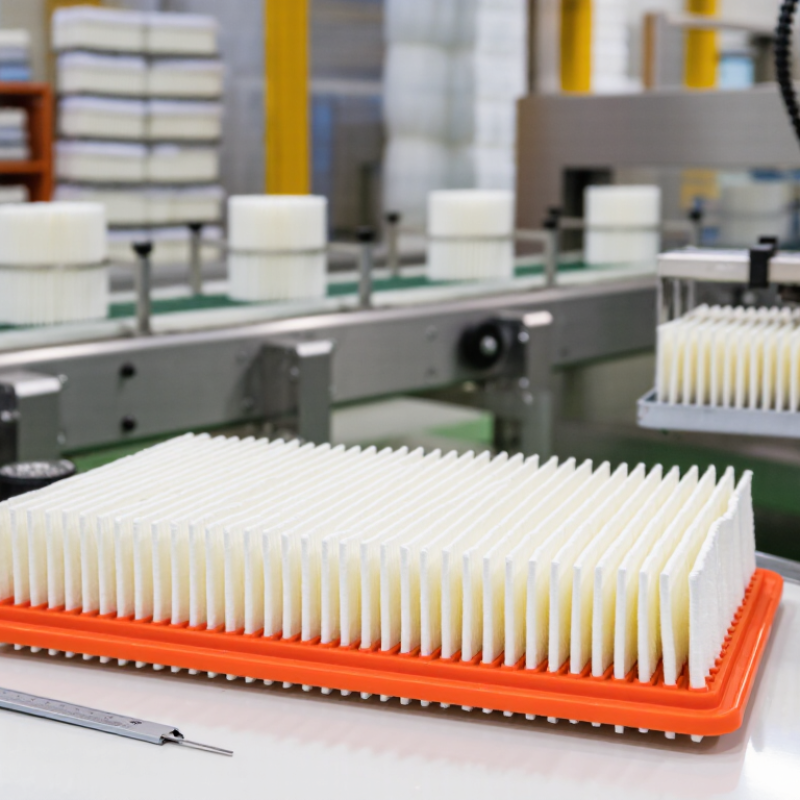
A car engine air filter cleans incoming air before combustion. It blocks dust, sand, pollen, and tiny road debris. It protects the engine. A dirty filter restricts airflow, especially during acceleration or heavy loading. The engine may feel slower, while fuel control becomes less stable. In real workshop checks, the filter often looks acceptable from above. The underside can still be heavily clogged.
The U.S. Department of Energy states that replacing a clogged filter improved acceleration by 6% to 11% in older carbureted vehicles. However, modern fuel-injected vehicles may show little fuel-economy improvement. That distinction matters.
ISO 5011 and SAE J726 evaluate filtration efficiency, pressure drop, and dust-holding capacity. These tests provide stronger evidence than appearance alone. A supplier should provide test results, material specifications, and batch traceability.
For a China-based supplier, quality depends on more than low pricing. Check pleat uniformity, sealing foam, filter-paper strength, and dimensional accuracy. A one-millimeter gap can let unfiltered air enter. That damage is gradual. It may not trigger a warning light. I would not promise dramatic mileage gains from every replacement. That claim needs reflection. A reliable supplier should match the filter to the engine, climate, service interval, and test standard. Repeated sampling is essential. One successful batch proves little.
China Best Car Engine Air Filter Supplier?
How to Evaluate Chinese Car Engine Air Filter Suppliers
A practical evaluation starts with the filter’s performance, not its catalog price. Ask for efficiency, pressure-drop, dust-holding, and burst-test data. These figures should match the exact filter model. A generic report proves very little. Request material specifications for filter media, sealing foam, adhesive, and supporting mesh. Check whether production batches are traceable.
Visit the factory when possible, or arrange a live video inspection. Look for clean assembly areas, calibrated testing equipment, and controlled storage. Ask how workers identify defective pleats, uneven seals, or damaged frames. Small faults matter. A poor gasket can allow unfiltered air into an engine. Samples should be tested before any large order. Measure dimensions carefully, because a difference of two millimeters may cause leakage.
Review the supplier’s quality system, inspection records, export experience, and response speed. Reliable suppliers explain problems clearly instead of promising everything. Confirm minimum order quantities, tooling charges, packaging strength, lead times, and replacement procedures. I have learned that the cheapest offer can become expensive after repeated rework. Still, a high price does not automatically mean better quality. Compare verified evidence from several suppliers. Keep written specifications and approved samples. One weakness remains easy to miss: supplier performance may change after the first shipment. Regular inspections are worth considering.
Recommended evaluation weight by purchasing and quality-control priority
Filtration efficiency, dust-holding capacity, and sealing accuracy should receive the highest priority because they directly affect engine protection and service life. Test evidence, production consistency, and delivery performance are also important when comparing potential suppliers.
When evaluating a car engine air filter supplier in China, start with documented product standards, not attractive claims. Ask for the supplier’s ISO 9001 quality management certificate and its current validity. For automotive production, IATF 16949 certification offers stronger evidence of controlled processes. Still, a certificate alone proves little about one specific filter.
Request test reports based on ISO 5011 or an equivalent recognized method. These reports should show filtration efficiency, dust-holding capacity, airflow resistance, and test conditions. Check whether the filter maintains performance after dust loading. A low initial pressure drop may look impressive, but poor sealing can quickly defeat it. Inspect gasket compression, pleat spacing, filter media uniformity, and resistance to moisture, oil mist, and vibration.
Ask for dimensional inspection records, batch traceability, material declarations, and a clear sampling plan. A reliable supplier should explain how rejected units are isolated and corrected. PPAP-style documentation can reveal process maturity, even when formal automotive approval is not required. I once focused too heavily on laboratory efficiency numbers. That was incomplete. Installation fit and sealing often caused more practical problems. Request independent retesting when results appear unusually perfect. Compare samples from different production batches, not only hand-selected pieces. Look for consistent labeling, sealed packaging, and storage guidance. Small details matter. A professional supplier welcomes these questions and provides verifiable records without avoiding technical weaknesses.
China Best Car Engine Air Filter Supplier?
Price alone can mislead. OICA recorded 93.5 million motor vehicles produced worldwide in 2023. That volume supports strong filter manufacturing capacity, but capacity is not the same as reliable supply. Compare material costs, tooling fees, packaging, inspection, and shipping separately. A low quotation may exclude mold replacement or testing charges. Request a landed-cost calculation for identical specifications. Then compare lead time, minimum order quantity, and payment terms.
Customization needs technical evidence. Ask for filter media type, pleat height, sealing material, airflow data, and dust-holding capacity. The ISO 5011 intake-air test method is useful for comparing filtration performance under controlled conditions. Check whether samples match mass production. One overlooked detail is dimensional tolerance. A slight frame change can cause leakage after installation. I have seen attractive samples fail during repeated vibration testing. That mistake is expensive, but it is also preventable.
Tips: Request a monthly capacity statement, not only an annual figure. Verify production with dated factory records, equipment lists, and recent inspection reports. Ask for a pilot order before signing large volumes. Compare defect rates and corrective-action speed. OICA data shows the market is large, yet demand can shift quickly. A supplier with 500,000 units of theoretical capacity may deliver far less during peak season. Capacity claims require evidence.
| Comparison Dimension | Entry-Level Benchmark | Mid-Range Benchmark | Premium Benchmark | What Buyers Should Verify |
|---|---|---|---|---|
| Indicative FOB Unit Price | Approximately US$1.50–3.50 per filter for simple, high-volume applications | Approximately US$3.50–8.00 per filter for common passenger-car applications | Approximately US$8.00–20.00+ per filter for large, specialized, or high-efficiency designs | Confirm filter size, media type, frame material, packaging, Incoterm, and order quantity before comparing prices. |
| Minimum Order Quantity | Typically 500–1,000 pieces per model | Typically 1,000–3,000 pieces per model | Often 3,000+ pieces for dedicated tooling or production planning | Ask whether the MOQ applies per model, per color, per packaging design, or per shipment. |
| Common Filter Media | Cellulose or basic synthetic blend | Synthetic nonwoven media or cellulose-synthetic composite | High-efficiency synthetic media, multilayer media, or specialty treated media | Request media specifications, basis weight, filtration efficiency, pressure-drop data, and supplier traceability. |
| Filtration Performance | Suitable for standard replacement use when tested against the required specification | Balanced particle retention and airflow for mainstream vehicle applications | Higher efficiency, dust-holding capacity, and controlled airflow for demanding applications | Use independent laboratory reports or test results based on ISO 5011 or the buyer's specified method. |
| Pressure Drop at Rated Airflow | Usually higher because of simpler media and construction | Moderate pressure drop with a balanced pleat design | Lower or more stable pressure drop through optimized media and pleat geometry | Compare results at the same airflow, filter dimensions, test dust, and test duration. |
| Dimensional Customization | Existing dimensions with limited changes | Custom length, width, height, pleat count, gasket, and frame details | Full design support, prototype development, and application-specific engineering | Check drawing revision control, dimensional tolerances, sealing performance, and sample approval procedures. |
| Tooling and Development Cost | Low or waived when an existing mold is used | Approximately US$300–1,500 for common custom components | Approximately US$1,500–5,000+ for complex tooling, prototypes, or dedicated fixtures | Clarify ownership, maintenance responsibility, modification fees, and refund terms after mass production. |
| Sample Lead Time | 3–7 working days when an existing model is available | 7–15 working days for modified dimensions or packaging | 15–30 working days for new tooling, prototypes, and laboratory testing | Separate sample manufacturing time from testing, approval, and courier transit time. |
| Mass-Production Lead Time | Approximately 15–25 working days after approval | Approximately 25–40 working days after approval | Approximately 40–60 working days for complex or heavily customized programs | Confirm raw-material availability, production schedule, inspection time, and peak-season capacity. |
| Production Capacity | Approximately 20,000–80,000 filters per month | Approximately 80,000–300,000 filters per month | Approximately 300,000–1,000,000+ filters per month across multiple lines | Verify capacity by product category, available shifts, equipment list, utilization rate, and recent shipment records. |
| Quality Management | Basic incoming, in-process, and final inspection | Documented quality procedures with batch records and sampling inspection | Formal quality system, traceability, process audits, and corrective-action controls | Request valid certification, inspection plans, nonconformance records, and lot traceability evidence. |
| Private-Label Packaging | Plain cartons and standard labels | Custom cartons, labels, barcodes, and multilingual instructions | Complete packaging development, retail presentation, serialization, and compliance support | Confirm artwork approval, barcode standards, packaging durability, carton dimensions, and export marking requirements. |
| Inspection and Testing Support | Basic dimensional and visual inspection | Airflow, pressure-drop, sealing, and material checks | Complete performance validation, third-party testing, and application-specific reports | Ensure test reports identify the exact sample, test method, airflow rate, dust loading, and acceptance criteria. |
| Best Fit for Buyer | Price-sensitive orders with stable specifications and high volume | Most aftermarket programs requiring balanced cost, quality, and flexibility | Long-term programs requiring engineering support, validation, and consistent global supply | Select based on total landed cost, verified performance, delivery reliability, and scalability—not unit price alone. |
Note: Price, MOQ, lead time, and capacity figures are indicative industry benchmarks for comparison purposes. Final values depend on filter dimensions, materials, testing requirements, packaging, order volume, and delivery terms.
China Best Car Engine Air Filter Supplier?
How to Verify the Best Supplier for Your Business Needs
Supplier selection should begin with evidence, not attractive product photos. Grand View Research reported that the global automotive filters market reached approximately USD 14.3 billion in 2023. It also forecasts continued growth through 2030. Estimates differ between reports, so treat market figures as context, not proof. Ask each Chinese supplier for ISO 9001 and IATF 16949 certificates. Verify certificate numbers directly with the issuing bodies.
Request an ISO 5011 test report for every proposed filter model. Check filtration efficiency, pressure drop, dust capacity, airflow, and test conditions. A low price means little if airflow falls after several hours. Inspect pleat spacing, sealing foam, adhesive quality, and media weight. Request production samples, then test them through an independent laboratory. Keep samples from the same batch shipped to customers. Small details expose large process problems.
Audit the factory’s traceability system, incoming-material checks, tooling control, and final inspection records. Ask for defect rates, monthly capacity, lead-time history, and corrective-action reports. Speak with two current customers, if possible. No scorecard is perfect. A polished audit can still miss weak seasonal capacity. Recheck performance during peak demand. Compare three suppliers using identical specifications and total landed cost. The strongest candidate should provide controlled documents, stable samples, transparent communication, and a realistic plan for tooling, packaging, and replacement claims.